ARE 5.0 – Don’t Forget about Time, Strategy, and Guessing

Passing the Architect Registration Exam, ARE 5.0, isn't just about knowing the exam content; it's also about strategy. You've got to apply multiple test-taking strategies to boost your odds. The truth is, time management is critical to squeeze every point out of this exam. There's no time to spare, especially when you get into the Case Study questions, which account for 10% to 20% of each exam.
So, lock yourself in a quiet room, log in to your NCARB Record, and spend some quality time with the ARE 5.0 Demonstration Exam. Don't worry about answering the questions correctly yet. Familiarity equals efficiency. Get used to navigating the interface and know what to expect. The more comfortable you are, the more time you'll save on test day.
TIP: Every ARE 5.0 question is one of three Item Types: Multiple Choice, Check-all-that-apply, and Hotspot. Self-contained questions are called Discrete Items, and questions for the Case Study scenarios are called Case Study Items.
ARE 5.0 Time
Again, this isn't about knowing the right answers. For that, you'll have to study. This is about strategy and time management. Let's look at the numbers:
- PcM: 2hrs 40 mins/65 questions = 2:28 per question
- PjM: 3hrs 0 mins/75 questions = 2:24 per question
- PA: 3hrs 0 mins/75 questions = 2:24 per question
- PPD: 4hrs 5 mins/100 questions = 2:27 per question
- PDD: 4hrs 5 mins/100 questions = 2:27 per question
- CE: 3hrs 0 mins/75 questions= 2:24 per question
For all six ARE 5.0 divisions, you've got an average of less than two and a half minutes to answer each question. Some questions take less time, some more, and some you won't get if you had all day. Unfortunately, 2.5 minutes per question doesn't allow much time to read the Case Study Scenarios, double-check your answers, or anything else, really. You'll need to shave a bit off the average to get through all the questions and tie up loose ends.
TIP: The exam interface is cumbersome. Info sometimes loads slowly, although NCARB has tried to refine the case studies in the revised 2026 version to improve loading time. They have also limited the number of resources to reduce unnecessary clicks and loading of multiple resources. Hopefully, this will increase your efficiency and decrease your blood pressure.
You can tackle the case studies at any time during the ARE exam. If you start with the Discrete Items (non-case study questions), after say, 30 minutes, use the Exam Summary tool to check how many questions you've answered.
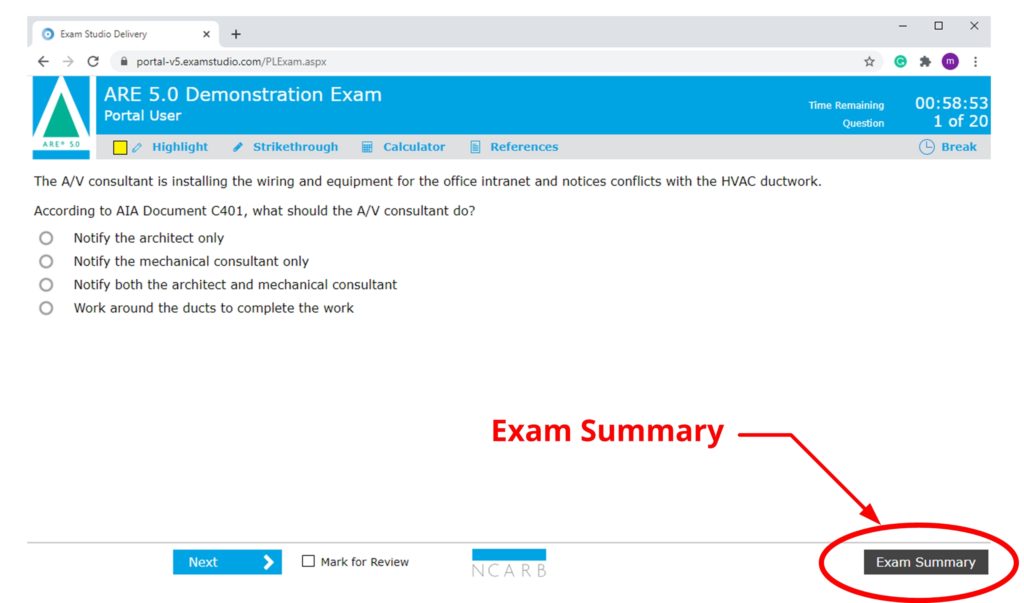
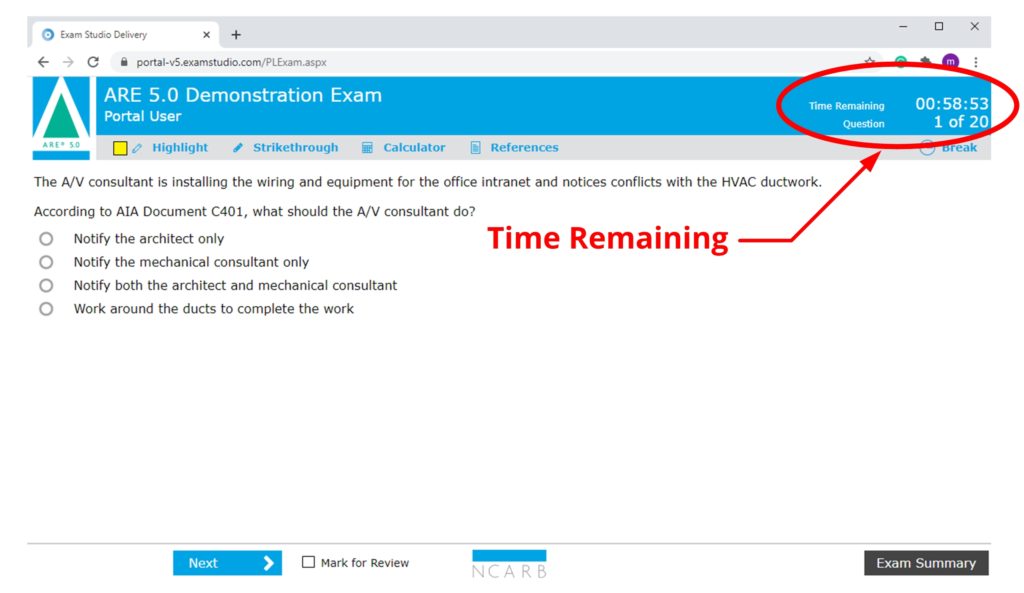
Then, check the Time Remaining clock. Determine how much time has passed, and if you're averaging >2 minutes or so (for discrete items), you’ll have to pick up the pace.
ARE 5.0 STRATEGY
Breaks are optional, but with appointments lasting up to 5 hours, you'll probably need at least one if not more. If you can plow through without stopping, great. If not, you need to plan ahead.
On the Project Planning & Design (PDD) division, for example, you get a total of 45 minutes of optional break time. Maybe you’ll take one long 45-minute break or three short 15-minute breaks. Whatever you decide, there’s a catch.
Each time you take a break, any ARE exam questions you’ve seen, answered, or not, will become locked. The same goes for case study questions. The scenarios and resources for any unseen case study questions remain unlocked, but if you’ve seen a question, it’ll be locked after a break. Consider each testing block like a self-contained exam. So, before you click the “Break” button, answer every ARE test question you saw during that testing block.
TIP: Scratch paper is not allowed during the ARE exam; instead, NCARB provides a digital "whiteboard." Get used to it before test day. Some ARE candidates hate it, some like it. Whatever your take, it's all you've got. Experiment with the NCARB practice exams, accessible through your My NCARB Account.
Okay, you're in the exam room (or your own room), you've started the exam, and the clock is ticking. But, before you start answering questions, get your bearings. The ARE 5.0 exam begins on the Exam Summary page. It takes just a few seconds to determine the number of Discrete Items (multiple-choice, check-all-that-apply, and hotspot), and the number of case studies and case study items.
Because answering a Case Study question relies on a particular Scenario and on the given Resource material, it takes longer than the 2+ minute average, but it's still worth only one point. Click the "Return to Exam" button to get started.
If you're starting with a case study, take note of the NCARB-provided Resource tabs. Don't spend much time digging into them. Just note which resources are available, so you know where to look for the answers.
Do, however, take a few minutes to familiarize yourself with the information in the Case Study Scenario tab. Read it carefully and let it percolate in the back of your mind while you get into the questions.
TIP: For PA, PPD, and PDD Divisions, get familiar with the IBC before your exam. You don't need to memorize it, but you should be familiar with its organization and chapter topics. Knowing how to look something up and where to find it will save you a ton of time during the ARE exam.
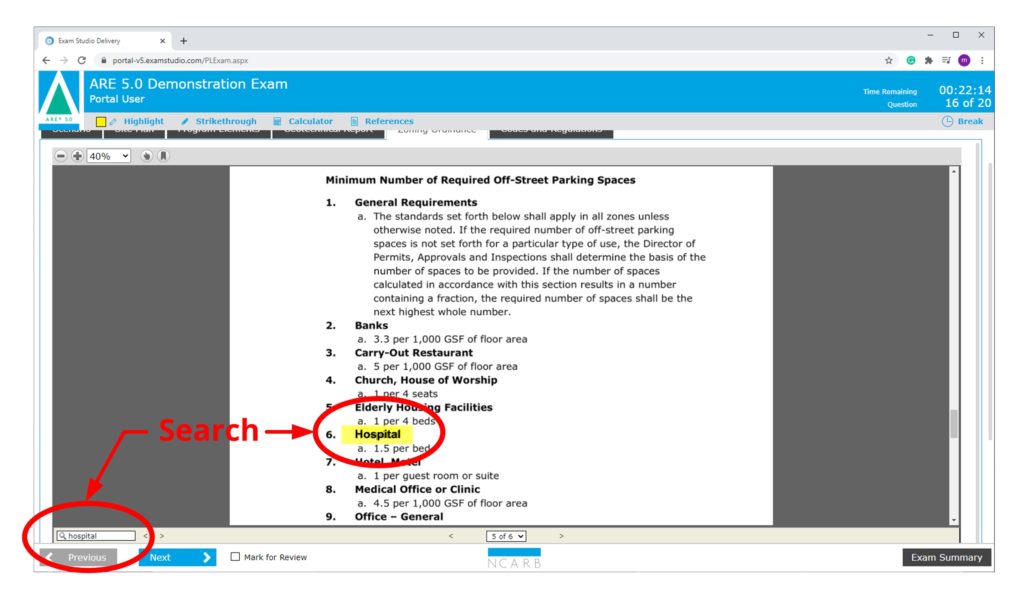
If you're not finding the right info in the Resources, use the Search feature. Searching for a key term within the tab will get you to the pertinent info more quickly.
An "easy'' question may take 30 seconds to answer. If you get it right, it's worth one point. But here's the thing. If it's going to take you 4+ minutes to answer a hard question, it's still worth only one point. Consider coming back to it later (before a break). Spend your time on the questions you're most likely to get right.
TIP: You can Highlight and Strikethrough text in the Scenario tab. BUT once you click Next or Previous, those markups disappear. Instead, mark up the questions and answers themselves. The markups will be there when you return.
When you get to a question that you can’t answer confidently, consider using the Highlighter tool to note key terms and/or possible answer choices. Also, use the Strikethrough tool to eliminate incorrect answer choices. If you have to come back to the question (again, before you take a break), you won’t have to start from scratch. Whenever possible, answer the question. Here's how to address ARE 5.0 questions you're unsure about.
If you have, say, 0% to 80% confidence in your answer, click the Mark for Review box
to flag the question. When you're ready to review your seen questions, before a break, click Exam Summary.
You'll see the questions you marked for review identified by a red flag. If you answered the question, it's labeled "Completed," if not, it's labeled "Incomplete." Now, click the Review Marked button to answer all of these questions.
Because unanswered ARE 5.0 questions are worth zero points, you need to answer every one to maximize your chances of passing, even if you have to make a wild guess. And yes, there's some strategy to it.
ARE 5.0 GUESSING?
With precious little time to tackle incomplete questions, you've gotta guess. The Discrete Items use the same three Item Types as the Case Studies, so the same recommendations apply.
For each ARE Item Type, there is a different time commitment and different odds of guessing the right answer. As you try to answer the marked questions, keep in mind the following recommendations for each Item Type, in order of value.
ARE Item Type: Multiple Choice Test Questions
Multiple-choice questions offer the best odds of guessing the correct answer. Answering blindfolded, your odds are 25%, or 33%, since some M.C. questions have only three answer choices. That's the same odds as winning a game of Rock, Paper, Scissors. Not bad. If you can eliminate one answer choice, now it's a coin flip, 50/50. Refer to your highlights and strikethroughs.
ARE Item Type: Hotspot
Hotspots require you to select a region of a drawing that represents the answer to the question. NCARB example, "Where is the thru-wall flashing required?" Once you make a decision, choosing a location only takes one click. Odds vary, so take your best shot.
ARE Item Type: Check-All-That-Apply
To answer these questions, you have to select the 2, 3, or 4 correct answer choices (out of six). Fortunately, NCARB tells you how many. For example, "Check the three that apply." Read carefully. It could be "two" or "four." If you're unsure about the correct answer choices, at least you know how many to select. Refer to your highlights and strikethroughs, try to eliminate any obviously incorrect options (distractors), and click the appropriate number of boxes.
Answer Everything!
It's like the lottery; You can't win if you don't play. To be clear, your priority while preparing for ARE 5.0 is to study hard and know your stuff. These ARE 5.0 strategies and recommendations will help you manage your time to avoid a last-minute meltdown. Time is short, you need every point you can get, and sometimes things get FUBAR. So, be as efficient as possible. Strategize by marking questions for review. And if you have to, guess.
Good luck from the CLARE crew!
Studying For ARE 5.0 — It’s Not Easy

Historically, candidates were tested in distinct repositories of information because the content covered by the Architect Registration Exam (ARE) was siloed. For example, all questions about mechanical systems were in one division, and questions about construction documents were in another. This compartmentalization made studying pretty straightforward. For the most part, it was one topic = one division. Studying for ARE 5.0, an exam that tests holistically, where the content is no longer isolated into its respective division, presents a significant challenge for candidates.
So why the change?
"To ensure all program requirements continue to evolve and align with where architectural practice is headed." As part of their 2012 Practice Analysis, NCARB developed an extensive survey aimed at "individuals from all career stages around the country to share their perspectives and help shape the future of architecture." The survey asked licensed architects to identify the tasks they perform and indicate how often they perform them, their importance, and when they acquired the knowledge /skill (K/S), before or after licensure. Then they asked them when they think the skill should be acquired. Most of the 865 respondents indicated they acquired the knowledge/skill after licensure, but believe today's candidates should acquire them before licensure.
According to NCARB "These responses both reinforce the importance of acquiring the K/S prior to licensure and highlight a knowledge gap, as architects acquired the K/S later than they believe is necessary." Although they recognized this knowledge gap, they used the responses as a guide to developing ARE 5.0.
Take a look at NCARB's demographic of respondents in their 2012 practice analysis survey:
- Received a Bachelor of Architecture degree (B.Arch) in the United States
- Has been licensed for more than 20 years in the United States or Canada
- Is a white male
- Works full-time as a principal in an equity position
- Has not served as an IDP supervisor/mentor
ARE 5.0 assesses candidates on knowledge and skills typically acquired through years of practice as a licensed architect. T David Cronrath, Chair ARE R&D Subcommittee explained ARE 5.0 this way: “we saw an opportunity for testing at higher levels of cognition through analytical, synthetic, and evaluative exercises—which would be more like what an architect does as part of regular practice—and have a high quality and reliable exam.” This testing model makes it easy for NCARB to test a candidate’s knowledge about a specific topic from the perspective of several divisions, e.g., relative to any phase of a project, and at any level of cognitive complexity.
Now, you must have an understanding of complex topics (many in which you have little to no experience) across multiple divisions. AXP is not going to fill the knowledge gap. Preparing for and passing the ARE 5.0 is not easy–it's not you.
Let's take the topic of project delivery methods as just one example.
In ARE 5.0, project delivery methods are tested in at least four divisions, Practice Management (PcM), Project Management (PjM), Project Development & Documentation (PDD), and Construction & Evaluation (CE). Previously, it was contained in one division. What’s unique is that each of the ARE 5.0 divisions deals with the topic of project delivery methods somewhat differently. For example:
- PcM: Which project delivery method is appropriate for a particular project?
- PjM: What documents does a particular project delivery method require?
- PDD: How does the project delivery method affect the drawing set?
- CE: What are the architect’s preconstruction responsibilities based on the delivery method?
Now, let’s look at project delivery methods in the context of an NCARB sample question:
An architecture firm is expanding into the healthcare market and has been selected to design a new hospital building on a previously undeveloped site. The client requires the use of design-bid-build delivery method. When preparing the proposal for professional services, which factors should the architect consider?
Check the three that apply.
- Capabilities of the contractor
- Requirements for a brownfield site assessment
- Level of risk associated with the project
- Project schedule
- Guaranteed maximum price (GMP)
- Specialty consultants required
Is this question from the Practice Management (PcM) division or the Project Management (PjM) division? It has a high level of cognitive complexity, there are several variables to consider, and a candidate must select multiple correct answer choices. This question happens to be from Practice Management (PcM). However, modify one or two variables in the question, and you could find it in almost any ARE 5.0 division.
What does all of this mean for you?
It means you must understand most topics holistically. Candidates often prepare for multiple divisions simultaneously based on exam content, and classify the six divisions into two groups:
- Practice Management (PcM)
- Project Management (PjM)
- Construction & Evaluation (CE)
and
- Programming & Analysis (PA)
- Project Planning & Design (PPD)
- Project Development & Documentation (PDD)
To better assess a candidate’s ability to practice architecture, the ARE 5.0 format seems like a step in the right direction, for the industry, perhaps. But, for candidates just trying to pass the tests, it adds additional challenges. Stay tuned for upcoming changes expected in 2027.
Making Sense of the ARE 5.0 Divisions
With each version of the Architect Registration Exam, NCARB attempts to make the ARE more reflective of the realities of practicing architecture. ARE 5.0 has come the closest thus far. Understanding the exam structure will help you maintain perspective as you approach each division. Due to overlap in the content within each group, some candidates find it beneficial to study for multiple divisions simultaneously. That approach does not work for everyone. What is helpful is studying the overlapping concepts, which you can do using CLARE's topic decks. Each exam contains similar content, but the focus differs. That's where continuing to study for several divisions up to exam day can backfire.
The six ARE 5.0 divisions can be sorted into two broad groups (with division 6, Construction & Evaluation (CE), including elements of both groups):
Group 1 - Management
NCARB wants to know whether you can manage an office and a project and whether you understand construction administration.
- Practice Management (PcM) - Division 1
- Project Management (PjM) - Division 2
- Construction & Evaluation (CE) - Division 6
Group 2 - The Project
NCARB wants to know if you understand the project itself. Think of this group in terms of the life of a project. Divisions 3, 4, 5, (& 6) align, more or less, with the progression of the phases of a typical project, from pre-schematic design (division 3) to post-construction (division 6).
- Programming & Analysis (PA) - Division 3
- Project Planning & Design (PPD - Division 4
- Project Development & Documentation (PDD) - Division 5
- Construction & Evaluation CE - Division 6
The Management Divisions
ARE 5.0 Division 1. Practice Management (PcM)
Practice Management covers everything that surrounds running an architecture practice. What does it mean to run a practice? How should you run the practice? This division covers activities that happen pre-contract. Once a contract is signed, you have an actual project and move into the next practice area (Project Management, Division 2).
ARE 5.0 Division 2. Project Management (PjM)
Project Management begins once the Owner/Architect agreement is signed and extends over the entire life of the project. It’s a real project with a project manager. PjM is heavy on contracts, processes, consultants, team make-up, and scheduling of the entire project. Can you enforce & apply what you developed in PcM? Do you understand the drawing set? How do you deliver project services per the contract? How do you communicate with the client, the contractors, etc.?
ARE 5.0 Division 6. Construction & Evaluation (CE)
At this point, specifications have been coordinated with the drawings, design development, and project documentation are complete. Construction & Evaluation includes bidding and negotiation topics, and the project has progressed into the construction contract administration phase. So, you’ll need to understand your role. What are your responsibilities and those of the owner and contractor? How do you communicate information to each of the parties involved? How do you address project changes and scheduling issues?
The Project Divisions
ARE Division 3. Programming & Analysis (PA)
Programming & Analysis activities occur early in a project, prior to the schematic design phase. PA examines topics such as context, codes, the site, the building, and the budget in general terms, within the programming and analysis phase of the project. As a result, this division requires a lot of information synthesis.
ARE 5.0 Division 4. Project Planning & Design (PPD)
Relative to the typical progression of an architecture project, think of this division as Programming, Planning & Design as a loose combination of schematic design and the early stages of the design development phase. In PPD, you’ll take the analysis from PA and make determinations based on it. What is the design going to be? What design alternatives must be considered? Can you evaluate different options and make a decision? Think of the PPD content in terms of 1/8” = 1’ or ¼” = 1’ scale, whereas the following division addresses specific design issues on a detail level.
ARE 5.0 Division 5. Project Development & Documentation (PDD)
Content in this division has progressed beyond schematic design and is well into the design development phase. Consider design issues in Project Development & Documentation at a more specific, detailed level, and how best to communicate the information to a contractor. Think ¾” = 1’ or 1 ½” = 1’, for example, whereas the previous division addressed design issues from a broader perspective. Because of the graphic nature of this division, you’re likely to encounter more hotspot item types.
—again— ARE 5.0 Division 6. Construction & Evaluation (CE)
Do you understand the construction process? Is the construction in accordance with the contract documents? Did they use the correct materials? Can you evaluate the completed project?
Thinking of the six ARE 5.0 divisions as comprised of two groups, practice & project management, and the progression of a project provides a framework for understanding the ARE holistically. As you take on any of the ARE 5.0 divisions, keep their parts in mind and consider how they fit into the practice of architecture. Applying this strategy will provide insight into the scope of each exam, helping you maintain focus and stay oriented.
Understanding Cognitive Complexity and the ARE 5.0
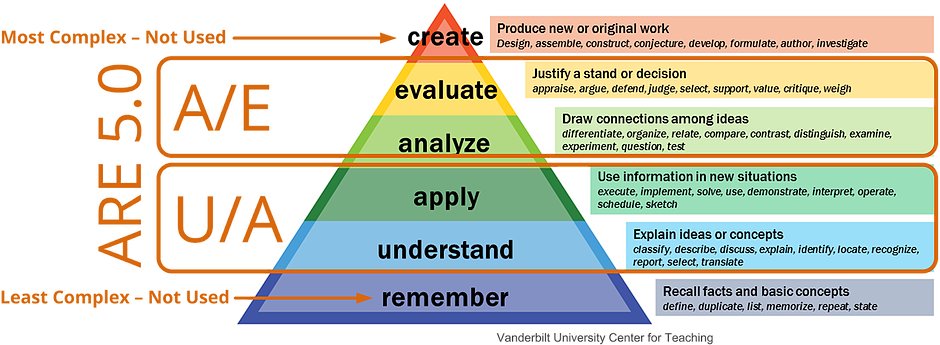
Within each ARE 5.0 division, specific learning objectives are defined with an expected level of cognitive complexity to assess your critical thinking skills. With the development of ARE 5.0, NCARB introduced two levels of cognition based on a modified model of Bloom's Taxonomy.
In this modified model, NCARB excluded the two extremes, “Remember” (lowest cognitive level) and “Create” (highest cognitive level), and combined the remaining four levels of knowledge into two: Understand/Apply (U/A) and Analyze/Evaluate (U/E).
● Understand/Apply – Construct meaning from written and graphic information and demonstrate an understanding of concepts or processes using the information in a new way. Understand a topic at a conceptual level, i.e., the ‘how and why.’ Demonstrate the logical application of knowledge through execution or implementation and the possible application of a mathematical formula.
● Analyze/Evaluate – Distinguish between different parts of a concept, how they relate to each other, and the overall structure and purpose based on stated criteria. Make judgments and justify decisions. Integrate and prioritize new information alongside existing information or non-standard scenarios.
NCARB's Cognitive Complexity Modified Model

The cognitive level "Remember" is not tested as an independent learning objective. However, Bloom's Taxonomy is hierarchical; thus, advancing to a higher level of cognitive complexity indicates that one has mastered the material at the lower levels. The ARE 5.0 questions are written with the assumption that you will remember (retrieve, recall, and recognize) the general concepts and facts required to understand, apply, analyze, and evaluate what is being asked.
Create, the highest level of cognitive complexity is not tested on the ARE 5.0. You are not required to show your ability to produce an original work.
Here’s what it means in practical terms.
Remember - What are the health benefits of eating apples?
Understand - Compare the health benefits of eating apples vs. oranges.
Apply - Would apples prevent scurvy, a disease caused by a deficiency in vitamin C?
Analyze – Which of the following ways of serving apples has the highest health benefits?
Evaluate - Which kinds of apples are best for baking a pie, and why?
Create - Convert an "unhealthy" apple pie recipe into a "healthy" one by replacing ingredients of your choice. Explain the health benefits of using the ingredients you chose vs. the original ones.
One Example at Each Level of Cognitive Complexity
Remember, Understand, Apply, Analyze, Evaluate, and Create
Remember (not directly tested)
On a standard traffic light, what three colors are represented?
A. Red, blue, orange
B. Red, yellow, blue
C. Red, yellow, green
D. Red, blue, green
Answer
C. Red, yellow, green
Rationale
All that is required to answer correctly is to remember relevant facts. No understanding of traffic lights is required. On the ARE 5.0, remembering facts is the foundation, the starting point for deeper understanding. ARE candidates are not tested at the lowest level of cognitive complexity (Remember).
Understand
On a standard traffic light, what does the red light mean?
A. Go
B. Caution
C. Yield
D. Stop
Answer
D. Stop
Rationale
Choosing the correct answer demonstrates an understanding of the facts, concepts, and procedures, i.e., the meaning of the standard traffic light colors. To answer this, you must also remember, recognize, and recall the facts.
Apply
On a standard traffic light, the yellow light is on. What will happen next?
A. Green will light
B. Red will light
C. Yellow will flash
D. Red will flash
Answer
B. Red will light
Rationale
Apply acquired knowledge, to respond, implement, and test a prediction. To answer this, you must also understand and remember the facts.
Analyze
On a standard traffic light at a four-way intersection, the red lights are flashing in all directions. What assumption can be made?
A. The traffic light is recently broken.
B. All oncoming traffic must stop.
C. Drivers must yield to those on their right.
D. Use caution when approaching.
Answer
B. All oncoming traffic must stop.
Rationale
Answering correctly requires the analysis of information to make inferences and draw conclusions. It also requires the ability to apply acquired knowledge, respond, implement, and test a prediction, understand, and remember the facts.
Evaluate
On a standard traffic light at a four-way intersection, the red lights are flashing in all directions. Two drivers meet at the intersection. Which of the following is the correct scenario?
A. The driver on the left must yield the right-of-way to the driver on the right.
B. The driver second to arrive at the intersection must yield to the first driver.
C. If the drivers arrive at the intersection simultaneously, the driver on the left must yield.
D. If the drivers arrive simultaneously from opposite directions, the driver turning left must yield.
Answer
D. If the drivers arrive simultaneously from opposite directions, the driver turning left must yield.
This is true in all cases.
Rationale
Answering correctly requires one to evaluate and make a judgment based on a set of criteria. It also requires analyzing information to draw conclusions, applying acquired knowledge, responding, implementing, and testing predictions, and understanding and remembering facts.
A. The driver on the left must yield the right-of-way to the driver on the right.
The driver on the left must yield to the driver on the right, but only if they arrive simultaneously, are perpendicular to one another, they will cross paths, or they want to go the same direction.
B. The driver second to arrive at the intersection must yield to the first driver.
The second driver to arrive must yield, but this is required only if they are perpendicular to one another, will cross paths, or if they both want to go the same direction.
C. If the drivers arrive at the intersection simultaneously, the driver on the left must yield.
This is true unless the drivers arrive from opposite directions.
Create (not tested)
While adhering to traffic rules, devise an alternate mechanism to the standard traffic light that will inform drivers of the appropriate behavior at a four-way intersection.
Refer to the ARE 5.0 Guidelines often as you study for each division. Consider the content covered by each objective. Pay attention to the ARE 5.0 required level of cognitive complexity and the underlying facts you are expected to remember from the lower level of knowledge. The cognitive level assigned to an objective can offer some insight into the knowledge and thinking skills expected.
Keep in mind, ARE questions are written by volunteers and vetted by people with varying levels of expertise, which “can influence the cognitive levels being measured.” In other words, the questions might not match your perception of U/A or A/E. The ARE 5.0 resource materials are not written with cognitive levels in mind. Just remember, Bloom’s Taxonomy is primarily a teaching tool, not a testing tool; it’s an imperfect system applied to an imperfect exam.
Learn more by breaking down an NCARB ARE 5.0 sample question.
ARE 5.0 Practice Tests – “That’s all I want.”

Are you seeking out practice tests for the ARE 5.0? Contrary to popular test prep strategies, third-party practice tests might not be the answer to your ARE woes. Time and again, we hear candidates say, “I knew all the answers on the practice tests; why did I fail?” or “The practice tests were nothing like the questions I had on the ARE exam!”
The ARE is a Standardized Test ... NOT!
ARE 5.0 is unlike other standardized tests. Using practice tests to prepare for exams like the ACT/SAT, GRE, and LSAT can improve your score. You can easily find actual tests used in the past to test your knowledge of predictable data under the prescribed time constraints and expect a similar outcome on test day. Practice tests for these exams are useful for analyzing performance. If you are weak in Algebra, you can practice solving similar problems over and over again. Taking numerous old versions of actual tests for practice will help you solve problems correctly and quickly on test day.
When it comes to the ARE 5.0, this is not the case. The most effective practice tests, however, are those from NCARB. Fortunately, they provide an exam for each division, updated in 2026. They are NOT questions from the actual exam, nor any past exam. Still, they're the best practice test you can take—well, almost. There's nothing quite like taking an actual ARE 5.0 exam. While time and cost are drawbacks here, there is no penalty for failing, and each retake is like a separate practice test. By taking the ARE 5.0, you’ll gain a sense of the depth of knowledge required and experience the actual test conditions and time constraints. Unlike practice exams, you won’t know which questions you got wrong or right, and there will not be any explanations. But, you will learn which content areas to focus on by reviewing your NCARB score report, get your feet wet, and know what to expect moving forward.
"Practice Effect"
Test developers and NCARB know that whenever a candidate takes the ARE 5.0, they have ‘practiced’ taking the exam. “The more ‘practices’ a candidate has, the better chance for a higher score. This increase in scores is called a practice effect, so NCARB has multiple forms in circulation for each division. Additionally, there is a waiting period of 60 days before you can retest a failed division. Certification examinations are designed to ensure that those achieving the credential possess the appropriate level of knowledge.” Test Development: Ten Steps to a Valid and Reliable Certification Exam
Actual ARE test questions aim to assess whether the candidate has enough knowledge in essential areas to practice architecture. NCARB questions and answer choices have been rigorously evaluated to determine their accuracy, efficacy, fairness, the appropriate level of cognitive complexity, and value in identifying strong, average, and weak candidates. A practice test question is only as good as its creator. Often, third-party practice questions are based on the creator’s study materials and are not subject to NCARB-level vetting, which they outline in the latest ARE Guidelines.
There are, however, two potential benefits to taking a third-party ARE 5.0 practice test: one is the answer explanations. This benefit depends on the quality and depth of the explanations given, not only for the correct answer but also why the other choices are wrong. And two, the benefit of actively recalling information that you’ve studied. With multiple-choice practice, you start memorizing the questions and correct answers instead of learning the actual content.
Doing It Anyway
ARE 5.0 practice exam results are not indicative of future performance and may give you an inaccurate sense of readiness. In a recent study from Harvard, researchers found that your “perception of how much you feel you’ve learned and understood does not correlate with what you’ve actually learned.” If you’re going to take practice tests anyway, use them to study the topics presented. Because unless you have the same question and answer choices on your actual ARE, you could be in trouble.
Breaking Down an NCARB ARE 5.0 Sample Question

NCARB's ARE 5.0 multiple-choice questions are written so that only one answer choice is the best option. Because the remaining answer choices (distractors) are plausible, it’s the ARE candidate’s job to dissect the question (stem) for clues as to why one answer choice is better than another. Take this NCARB ARE 5.0 sample question, for example.
During a routine site visit, the owner tells the architect to change the layout of two interior framed walls the contractor has already framed based on the construction documents. The framing changes will not have an impact on any code-related issues. Since the owner is adamant the walls be reframed, which of the following should the architect do?
A. Ask the contractor to schedule a meeting on-site with the owner, architect, and framing subcontractor to review the changes
B. Review the expected effect on construction cost and schedule with the contractor, then prepare a change order for owner review
C. Issue a construction change directive, with a requirement for time and material invoices to be submitted for the work
D. Include documentation of the discussion and a drawing
Let’s break this ARE question stem down into its various elements:
"During a routine site visit,"
It was not one of the architect’s two required inspections (no substantial/final completion issues).
"the owner tells the architect to change the layout of two interior framed walls"
The owner wants something changed. Presumably, the owner does not expect the architect to pick up a hammer and begin reframing.
"the contractor has already framed based on the construction documents."
That portion of the work is done and it is in accordance with the construction documents.
"The framing changes will not have an impact on any code-related issues."
The proposed changes are within the general scope of the contract.
"The owner is adamant the walls be reframed per their new request."
The proposed changes must be made.
Which of the following should the architect do?
A. Ask the contractor to schedule a meeting on-site with the owner, architect, and framing subcontractor to review the changes
B. Review the expected effect on construction cost and schedule with the contractor, then prepare a change order for owner review
C. Issue a construction change directive, with a requirement for time and material invoices to be submitted for the work
D. Include documentation of the discussion and a drawing
Many candidates choose “B” (prepare a change order), which seems reasonable. However, the most correct answer choice is “C” (issue a construction change directive).
Why? Because the owner is “adamant.” This is the one clue to selecting the correct answer. Even though the contractor and owner have yet to agree on any change in cost or time, the owner’s inexorable decision to change the layout of the two walls can be ordered via a construction change directive.
Here’s the relevant article from AIA Document A201-2017:
§ 7.3.1
A Construction Change Directive is a written order prepared by the Architect and signed by the Owner and the Architect, directing a change in the Work prior to agreement on any adjustment to the Contract Sum or Contract Time, or both. The Owner may by Construction Change Directive, without invalidating the Contract, order changes in the Work within the general scope of the Contract consisting of additions, deletions or other revisions, the Contract Sum and Contract Time being adjusted accordingly.
In reality, depending on the scope of the requested change, one of several scenarios might play out. It’s possible that, if the contractor is feeling particularly charitable, the walls might just be reframed, no questions asked. However, because the owner is “adamant,” there is only one best option. If the owner were merely interested, any of the answer choice distractors might suffice.