Studying For ARE 5.0 — It’s Not Easy

Historically, candidates were tested in distinct repositories of information because the content covered by the Architect Registration Exam (ARE) was siloed. For example, all questions about mechanical systems were in one division, and questions about construction documents were in another. This compartmentalization made studying pretty straightforward. For the most part, it was one topic = one division. Studying for ARE 5.0, an exam that tests holistically, where the content is no longer isolated into its respective division, presents a significant challenge for candidates.
So why the change?
"To ensure all program requirements continue to evolve and align with where architectural practice is headed." As part of their 2012 Practice Analysis, NCARB developed an extensive survey aimed at "individuals from all career stages around the country to share their perspectives and help shape the future of architecture." The survey asked licensed architects to identify the tasks they perform and indicate how often they perform them, their importance, and when they acquired the knowledge /skill (K/S), before or after licensure. Then they asked them when they think the skill should be acquired. Most of the 865 respondents indicated they acquired the knowledge/skill after licensure, but believe today's candidates should acquire them before licensure.
According to NCARB "These responses both reinforce the importance of acquiring the K/S prior to licensure and highlight a knowledge gap, as architects acquired the K/S later than they believe is necessary." Although they recognized this knowledge gap, they used the responses as a guide to developing ARE 5.0.
Take a look at NCARB's demographic of respondents in their 2012 practice analysis survey:
- Received a Bachelor of Architecture degree (B.Arch) in the United States
- Has been licensed for more than 20 years in the United States or Canada
- Is a white male
- Works full-time as a principal in an equity position
- Has not served as an IDP supervisor/mentor
ARE 5.0 assesses candidates on knowledge and skills typically acquired through years of practice as a licensed architect. T David Cronrath, Chair ARE R&D Subcommittee explained ARE 5.0 this way: “we saw an opportunity for testing at higher levels of cognition through analytical, synthetic, and evaluative exercises—which would be more like what an architect does as part of regular practice—and have a high quality and reliable exam.” This testing model makes it easy for NCARB to test a candidate’s knowledge about a specific topic from the perspective of several divisions, e.g., relative to any phase of a project, and at any level of cognitive complexity.
Now, you must have an understanding of complex topics (many in which you have little to no experience) across multiple divisions. AXP is not going to fill the knowledge gap. Preparing for and passing the ARE 5.0 is not easy–it's not you.
Let's take the topic of project delivery methods as just one example.
In ARE 5.0, project delivery methods are tested in at least four divisions, Practice Management (PcM), Project Management (PjM), Project Development & Documentation (PDD), and Construction & Evaluation (CE). Previously, it was contained in one division. What’s unique is that each of the ARE 5.0 divisions deals with the topic of project delivery methods somewhat differently. For example:
- PcM: Which project delivery method is appropriate for a particular project?
- PjM: What documents does a particular project delivery method require?
- PDD: How does the project delivery method affect the drawing set?
- CE: What are the architect’s preconstruction responsibilities based on the delivery method?
Now, let’s look at project delivery methods in the context of an NCARB sample question:
An architecture firm is expanding into the healthcare market and has been selected to design a new hospital building on a previously undeveloped site. The client requires the use of design-bid-build delivery method. When preparing the proposal for professional services, which factors should the architect consider?
Check the three that apply.
- Capabilities of the contractor
- Requirements for a brownfield site assessment
- Level of risk associated with the project
- Project schedule
- Guaranteed maximum price (GMP)
- Specialty consultants required
Is this question from the Practice Management (PcM) division or the Project Management (PjM) division? It has a high level of cognitive complexity, there are several variables to consider, and a candidate must select multiple correct answer choices. This question happens to be from Practice Management (PcM). However, modify one or two variables in the question, and you could find it in almost any ARE 5.0 division.
What does all of this mean for you?
It means you must understand most topics holistically. Candidates often prepare for multiple divisions simultaneously based on exam content, and classify the six divisions into two groups:
- Practice Management (PcM)
- Project Management (PjM)
- Construction & Evaluation (CE)
and
- Programming & Analysis (PA)
- Project Planning & Design (PPD)
- Project Development & Documentation (PDD)
To better assess a candidate’s ability to practice architecture, the ARE 5.0 format seems like a step in the right direction, for the industry, perhaps. But, for candidates just trying to pass the tests, it adds additional challenges. Stay tuned for upcoming changes expected in 2027.
Making Sense of the ARE 5.0 Divisions

With each version of the Architect Registration Exam, NCARB attempts to make the ARE more reflective of the realities of practicing architecture. ARE 5.0 has come the closest thus far. Understanding the exam structure will help you maintain perspective as you approach each division. Due to overlap in the content within each group, some candidates find it beneficial to study for multiple divisions simultaneously. That approach does not work for everyone. What is helpful is studying the... Read More
Understanding Cognitive Complexity and the ARE 5.0
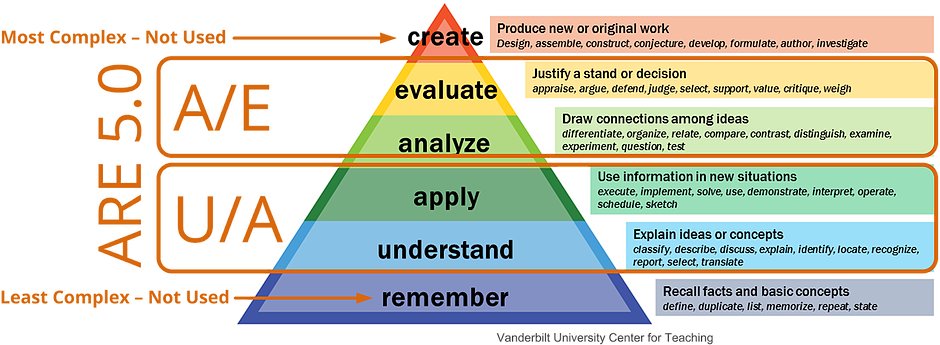
Within each ARE 5.0 division, specific learning objectives are defined with an expected level of cognitive complexity to assess your critical thinking skills. With the development of ARE 5.0, NCARB introduced two levels of cognition based on a modified model of Bloom's Taxonomy. In this modified model, NCARB excluded the two extremes, “Remember” (lowest cognitive level) and “Create” (highest cognitive level), and combined the remaining four levels of knowledge into two:... Read More
ARE 5.0 Practice Tests – “That’s all I want.”

Are you seeking out practice tests for the ARE 5.0? Contrary to popular test prep strategies, third-party practice tests might not be the answer to your ARE woes. Time and again, we hear candidates say, “I knew all the answers on the practice tests; why did I fail?” or “The practice tests were nothing like the questions I had on the ARE exam!” The ARE is a Standardized Test ... NOT! ARE 5.0 is unlike other standardized tests. Using practice tests to prepare for exams like the... Read More
Breaking Down an NCARB ARE 5.0 Sample Question

NCARB's ARE 5.0 multiple-choice questions are written so that only one answer choice is the best option. Because the remaining answer choices (distractors) are plausible, it’s the ARE candidate’s job to dissect the question (stem) for clues as to why one answer choice is better than another. Take this NCARB ARE 5.0 sample question, for example. During a routine site visit, the owner tells the architect to change the layout of two interior framed walls the contractor has already framed... Read More
ARE 5.0 – Don’t Forget about Time, Strategy, and Guessing

Passing the Architect Registration Exam, ARE 5.0, isn't just about knowing the exam content; it's also about strategy. You've got to apply multiple test-taking strategies to boost your odds. The truth is, time management is critical to squeeze every point out of this exam. There's no time to spare, especially when you get into the Case Study questions, which account for 10% to 20% of each exam. So, lock yourself in a quiet room, log in to your NCARB Record, and spend some quality time with... Read More