Understanding Cognitive Complexity and the ARE 5.0
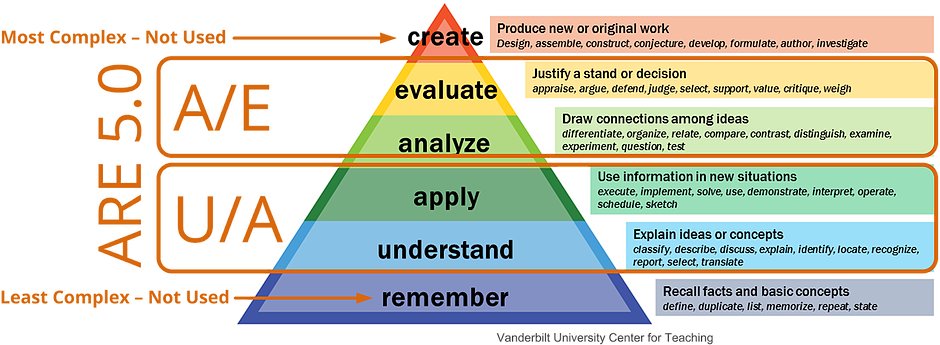
Within each ARE 5.0 division, specific learning objectives are defined with an expected level of cognitive complexity to assess your critical thinking skills. With the development of ARE 5.0, NCARB introduced two levels of cognition based on a modified model of Bloom's Taxonomy.
In this modified model, NCARB excluded the two extremes, “Remember” (lowest cognitive level) and “Create” (highest cognitive level), and combined the remaining four levels of knowledge into two: Understand/Apply (U/A) and Analyze/Evaluate (U/E).
● Understand/Apply – Construct meaning from written and graphic information and demonstrate an understanding of concepts or processes using the information in a new way. Understand a topic at a conceptual level, i.e., the ‘how and why.’ Demonstrate the logical application of knowledge through execution or implementation and the possible application of a mathematical formula.
● Analyze/Evaluate – Distinguish between different parts of a concept, how they relate to each other, and the overall structure and purpose based on stated criteria. Make judgments and justify decisions. Integrate and prioritize new information alongside existing information or non-standard scenarios.
NCARB's Cognitive Complexity Modified Model
The cognitive level "Remember" is not tested as an independent learning objective. However, Bloom's Taxonomy is hierarchical; thus, advancing to a higher level of cognitive complexity indicates that one has mastered the material at the lower levels. The ARE 5.0 questions are written with the assumption that you will remember (retrieve, recall, and recognize) the general concepts and facts required to understand, apply, analyze, and evaluate what is being asked.
Create, the highest level of cognitive complexity is not tested on the ARE 5.0. You are not required to show your ability to produce an original work.
Here’s what it means in practical terms.
Remember - What are the health benefits of eating apples?
Understand - Compare the health benefits of eating apples vs. oranges.
Apply - Would apples prevent scurvy, a disease caused by a deficiency in vitamin C?
Analyze – Which of the following ways of serving apples has the highest health benefits?
Evaluate - Which kinds of apples are best for baking a pie, and why?
Create - Convert an "unhealthy" apple pie recipe into a "healthy" one by replacing ingredients of your choice. Explain the health benefits of using the ingredients you chose vs. the original ones.
One Example at Each Level of Cognitive Complexity
Remember, Understand, Apply, Analyze, Evaluate, and Create
Remember (not directly tested)
On a standard traffic light, what three colors are represented?
A. Red, blue, orange
B. Red, yellow, blue
C. Red, yellow, green
D. Red, blue, green
Answer
C. Red, yellow, green
Rationale
All that is required to answer correctly is to remember relevant facts. No understanding of traffic lights is required. On the ARE 5.0, remembering facts is the foundation, the starting point for deeper understanding. ARE candidates are not tested at the lowest level of cognitive complexity (Remember).
Understand
On a standard traffic light, what does the red light mean?
A. Go
B. Caution
C. Yield
D. Stop
Answer
D. Stop
Rationale
Choosing the correct answer demonstrates an understanding of the facts, concepts, and procedures, i.e., the meaning of the standard traffic light colors. To answer this, you must also remember, recognize, and recall the facts.
Apply
On a standard traffic light, the yellow light is on. What will happen next?
A. Green will light
B. Red will light
C. Yellow will flash
D. Red will flash
Answer
B. Red will light
Rationale
Apply acquired knowledge, to respond, implement, and test a prediction. To answer this, you must also understand and remember the facts.
Analyze
On a standard traffic light at a four-way intersection, the red lights are flashing in all directions. What assumption can be made?
A. The traffic light is recently broken.
B. All oncoming traffic must stop.
C. Drivers must yield to those on their right.
D. Use caution when approaching.
Answer
B. All oncoming traffic must stop.
Rationale
Answering correctly requires the analysis of information to make inferences and draw conclusions. It also requires the ability to apply acquired knowledge, respond, implement, and test a prediction, understand, and remember the facts.
Evaluate
On a standard traffic light at a four-way intersection, the red lights are flashing in all directions. Two drivers meet at the intersection. Which of the following is the correct scenario?
A. The driver on the left must yield the right-of-way to the driver on the right.
B. The driver second to arrive at the intersection must yield to the first driver.
C. If the drivers arrive at the intersection simultaneously, the driver on the left must yield.
D. If the drivers arrive simultaneously from opposite directions, the driver turning left must yield.
Answer
D. If the drivers arrive simultaneously from opposite directions, the driver turning left must yield.
This is true in all cases.
Rationale
Answering correctly requires one to evaluate and make a judgment based on a set of criteria. It also requires analyzing information to draw conclusions, applying acquired knowledge, responding, implementing, and testing predictions, and understanding and remembering facts.
A. The driver on the left must yield the right-of-way to the driver on the right.
The driver on the left must yield to the driver on the right, but only if they arrive simultaneously, are perpendicular to one another, they will cross paths, or they want to go the same direction.
B. The driver second to arrive at the intersection must yield to the first driver.
The second driver to arrive must yield, but this is required only if they are perpendicular to one another, will cross paths, or if they both want to go the same direction.
C. If the drivers arrive at the intersection simultaneously, the driver on the left must yield.
This is true unless the drivers arrive from opposite directions.
Create (not tested)
While adhering to traffic rules, devise an alternate mechanism to the standard traffic light that will inform drivers of the appropriate behavior at a four-way intersection.
Refer to the ARE 5.0 Guidelines often as you study for each division. Consider the content covered by each objective. Pay attention to the ARE 5.0 required level of cognitive complexity and the underlying facts you are expected to remember from the lower level of knowledge. The cognitive level assigned to an objective can offer some insight into the knowledge and thinking skills expected.
Keep in mind, ARE questions are written by volunteers and vetted by people with varying levels of expertise, which “can influence the cognitive levels being measured.” In other words, the questions might not match your perception of U/A or A/E. The ARE 5.0 resource materials are not written with cognitive levels in mind. Just remember, Bloom’s Taxonomy is primarily a teaching tool, not a testing tool; it’s an imperfect system applied to an imperfect exam.
Learn more by breaking down an NCARB ARE 5.0 sample question.
ARE 5.0 Practice Tests – “That’s all I want.”

Are you seeking out practice tests for the ARE 5.0? Contrary to popular test prep strategies, third-party practice tests might not be the answer to your ARE woes. Time and again, we hear candidates say, “I knew all the answers on the practice tests; why did I fail?” or “The practice tests were nothing like the questions I had on the ARE exam!” The ARE is a Standardized Test ... NOT! ARE 5.0 is unlike other standardized tests. Using practice tests to prepare for exams like the... Read More
Breaking Down an NCARB ARE 5.0 Sample Question

NCARB's ARE 5.0 multiple-choice questions are written so that only one answer choice is the best option. Because the remaining answer choices (distractors) are plausible, it’s the ARE candidate’s job to dissect the question (stem) for clues as to why one answer choice is better than another. Take this NCARB ARE 5.0 sample question, for example. During a routine site visit, the owner tells the architect to change the layout of two interior framed walls the contractor has already framed... Read More
ARE 5.0 – Don’t Forget about Time, Strategy, and Guessing

Passing the Architect Registration Exam, ARE 5.0, isn't just about knowing the exam content; it's also about strategy. You've got to apply multiple test-taking strategies to boost your odds. The truth is, time management is critical to squeeze every point out of this exam. There's no time to spare, especially when you get into the Case Study questions, which account for 10% to 20% of each exam. So, lock yourself in a quiet room, log in to your NCARB Record, and spend some quality time with... Read More
Studying For ARE 5.0 — It’s Not Easy

Historically, candidates were tested in distinct repositories of information because the content covered by the Architect Registration Exam (ARE) was siloed. For example, all questions about mechanical systems were in one division, and questions about construction documents were in another. This compartmentalization made studying pretty straightforward. For the most part, it was one topic = one division. Studying for ARE 5.0, an exam that tests holistically, where the content is no longer... Read More
Making Sense of the ARE 5.0 Divisions

With each version of the Architect Registration Exam, NCARB attempts to make the ARE more reflective of the realities of practicing architecture. ARE 5.0 has come the closest thus far. Understanding the exam structure will help you maintain perspective as you approach each division. Due to overlap in the content within each group, some candidates find it beneficial to study for multiple divisions simultaneously. That approach does not work for everyone. What is helpful is studying the... Read More