Making Sense of the ARE 5.0 Divisions

With each version of the Architect Registration Exam, NCARB attempts to make the ARE more reflective of the realities of practicing architecture. ARE 5.0 has come the closest thus far. Understanding the exam structure will help you maintain perspective as you approach each division. Due to overlap in the content within each group, some candidates find it beneficial to study for multiple divisions simultaneously. That approach does not work for everyone. What is helpful is studying the overlapping concepts, which you can do using CLARE's topic decks. Each exam contains similar content, but the focus differs. That's where continuing to study for several divisions up to exam day can backfire.
The six ARE 5.0 divisions can be sorted into two broad groups (with division 6, Construction & Evaluation (CE), including elements of both groups):
Group 1 - Management
NCARB wants to know whether you can manage an office and a project and whether you understand construction administration.
- Practice Management (PcM) - Division 1
- Project Management (PjM) - Division 2
- Construction & Evaluation (CE) - Division 6
Group 2 - The Project
NCARB wants to know if you understand the project itself. Think of this group in terms of the life of a project. Divisions 3, 4, 5, (& 6) align, more or less, with the progression of the phases of a typical project, from pre-schematic design (division 3) to post-construction (division 6).
- Programming & Analysis (PA) - Division 3
- Project Planning & Design (PPD - Division 4
- Project Development & Documentation (PDD) - Division 5
- Construction & Evaluation CE - Division 6
The Management Divisions
ARE 5.0 Division 1. Practice Management (PcM)
Practice Management covers everything that surrounds running an architecture practice. What does it mean to run a practice? How should you run the practice? This division covers activities that happen pre-contract. Once a contract is signed, you have an actual project and move into the next practice area (Project Management, Division 2).
ARE 5.0 Division 2. Project Management (PjM)
Project Management begins once the Owner/Architect agreement is signed and extends over the entire life of the project. It’s a real project with a project manager. PjM is heavy on contracts, processes, consultants, team make-up, and scheduling of the entire project. Can you enforce & apply what you developed in PcM? Do you understand the drawing set? How do you deliver project services per the contract? How do you communicate with the client, the contractors, etc.?
ARE 5.0 Division 6. Construction & Evaluation (CE)
At this point, specifications have been coordinated with the drawings, design development, and project documentation are complete. Construction & Evaluation includes bidding and negotiation topics, and the project has progressed into the construction contract administration phase. So, you’ll need to understand your role. What are your responsibilities and those of the owner and contractor? How do you communicate information to each of the parties involved? How do you address project changes and scheduling issues?
The Project Divisions
ARE Division 3. Programming & Analysis (PA)
Programming & Analysis activities occur early in a project, prior to the schematic design phase. PA examines topics such as context, codes, the site, the building, and the budget in general terms, within the programming and analysis phase of the project. As a result, this division requires a lot of information synthesis.
ARE 5.0 Division 4. Project Planning & Design (PPD)
Relative to the typical progression of an architecture project, think of this division as Programming, Planning & Design as a loose combination of schematic design and the early stages of the design development phase. In PPD, you’ll take the analysis from PA and make determinations based on it. What is the design going to be? What design alternatives must be considered? Can you evaluate different options and make a decision? Think of the PPD content in terms of 1/8” = 1’ or ¼” = 1’ scale, whereas the following division addresses specific design issues on a detail level.
ARE 5.0 Division 5. Project Development & Documentation (PDD)
Content in this division has progressed beyond schematic design and is well into the design development phase. Consider design issues in Project Development & Documentation at a more specific, detailed level, and how best to communicate the information to a contractor. Think ¾” = 1’ or 1 ½” = 1’, for example, whereas the previous division addressed design issues from a broader perspective. Because of the graphic nature of this division, you’re likely to encounter more hotspot item types.
—again— ARE 5.0 Division 6. Construction & Evaluation (CE)
Do you understand the construction process? Is the construction in accordance with the contract documents? Did they use the correct materials? Can you evaluate the completed project?
Thinking of the six ARE 5.0 divisions as comprised of two groups, practice & project management, and the progression of a project provides a framework for understanding the ARE holistically. As you take on any of the ARE 5.0 divisions, keep their parts in mind and consider how they fit into the practice of architecture. Applying this strategy will provide insight into the scope of each exam, helping you maintain focus and stay oriented.
Understanding Cognitive Complexity and the ARE 5.0
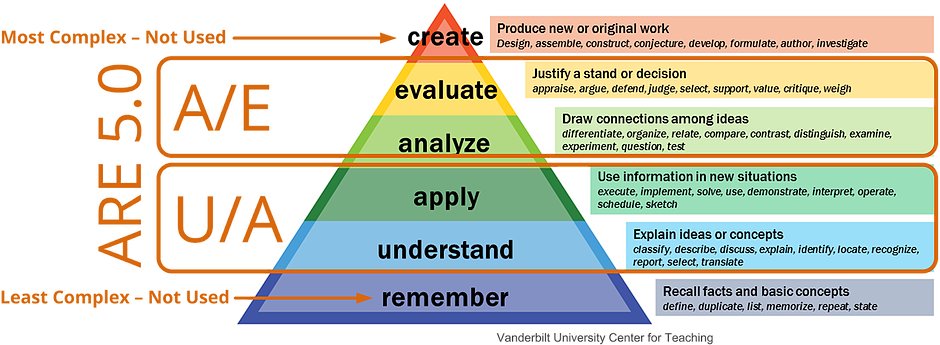
Within each ARE 5.0 division, specific learning objectives are defined with an expected level of cognitive complexity to assess your critical thinking skills. With the development of ARE 5.0, NCARB introduced two levels of cognition based on a modified model of Bloom's Taxonomy. In this modified model, NCARB excluded the two extremes, “Remember” (lowest cognitive level) and “Create” (highest cognitive level), and combined the remaining four levels of knowledge into two:... Read More
ARE 5.0 Practice Tests – “That’s all I want.”

Are you seeking out practice tests for the ARE 5.0? Contrary to popular test prep strategies, third-party practice tests might not be the answer to your ARE woes. Time and again, we hear candidates say, “I knew all the answers on the practice tests; why did I fail?” or “The practice tests were nothing like the questions I had on the ARE exam!” The ARE is a Standardized Test ... NOT! ARE 5.0 is unlike other standardized tests. Using practice tests to prepare for exams like the... Read More
Breaking Down an NCARB ARE 5.0 Sample Question

NCARB's ARE 5.0 multiple-choice questions are written so that only one answer choice is the best option. Because the remaining answer choices (distractors) are plausible, it’s the ARE candidate’s job to dissect the question (stem) for clues as to why one answer choice is better than another. Take this NCARB ARE 5.0 sample question, for example. During a routine site visit, the owner tells the architect to change the layout of two interior framed walls the contractor has already framed... Read More
ARE 5.0 – Don’t Forget about Time, Strategy, and Guessing

Passing the Architect Registration Exam, ARE 5.0, isn't just about knowing the exam content; it's also about strategy. You've got to apply multiple test-taking strategies to boost your odds. The truth is, time management is critical to squeeze every point out of this exam. There's no time to spare, especially when you get into the Case Study questions, which account for 10% to 20% of each exam. So, lock yourself in a quiet room, log in to your NCARB Record, and spend some quality time with... Read More
Studying For ARE 5.0 — It’s Not Easy

Historically, candidates were tested in distinct repositories of information because the content covered by the Architect Registration Exam (ARE) was siloed. For example, all questions about mechanical systems were in one division, and questions about construction documents were in another. This compartmentalization made studying pretty straightforward. For the most part, it was one topic = one division. Studying for ARE 5.0, an exam that tests holistically, where the content is no longer... Read More