ARE 5.0 – Don’t Forget about Time, Strategy, and Guessing

Passing the Architect Registration Exam, ARE 5.0, isn't just about knowing the exam content; it's also about strategy. You've got to apply multiple test-taking strategies to boost your odds. The truth is, time management is critical to squeeze every point out of this exam. There's no time to spare, especially when you get into the Case Study questions, which account for 10% to 20% of each exam.
So, lock yourself in a quiet room, log in to your NCARB Record, and spend some quality time with the ARE 5.0 Demonstration Exam. Don't worry about answering the questions correctly yet. Familiarity equals efficiency. Get used to navigating the interface and know what to expect. The more comfortable you are, the more time you'll save on test day.
TIP: Every ARE 5.0 question is one of three Item Types: Multiple Choice, Check-all-that-apply, and Hotspot. Self-contained questions are called Discrete Items, and questions for the Case Study scenarios are called Case Study Items.
ARE 5.0 Time
Again, this isn't about knowing the right answers. For that, you'll have to study. This is about strategy and time management. Let's look at the numbers:
- PcM: 2hrs 40 mins/65 questions = 2:28 per question
- PjM: 3hrs 0 mins/75 questions = 2:24 per question
- PA: 3hrs 0 mins/75 questions = 2:24 per question
- PPD: 4hrs 5 mins/100 questions = 2:27 per question
- PDD: 4hrs 5 mins/100 questions = 2:27 per question
- CE: 3hrs 0 mins/75 questions= 2:24 per question
For all six ARE 5.0 divisions, you've got an average of less than two and a half minutes to answer each question. Some questions take less time, some more, and some you won't get if you had all day. Unfortunately, 2.5 minutes per question doesn't allow much time to read the Case Study Scenarios, double-check your answers, or anything else, really. You'll need to shave a bit off the average to get through all the questions and tie up loose ends.
TIP: The exam interface is cumbersome. Info sometimes loads slowly, although NCARB has tried to refine the case studies in the revised 2026 version to improve loading time. They have also limited the number of resources to reduce unnecessary clicks and loading of multiple resources. Hopefully, this will increase your efficiency and decrease your blood pressure.
You can tackle the case studies at any time during the ARE exam. If you start with the Discrete Items (non-case study questions), after say, 30 minutes, use the Exam Summary tool to check how many questions you've answered.
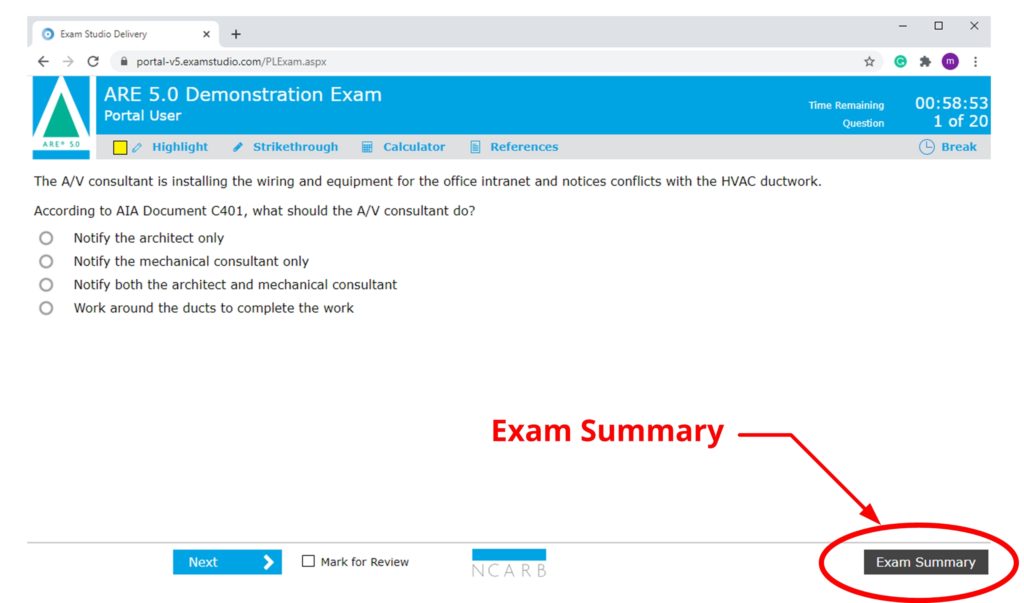
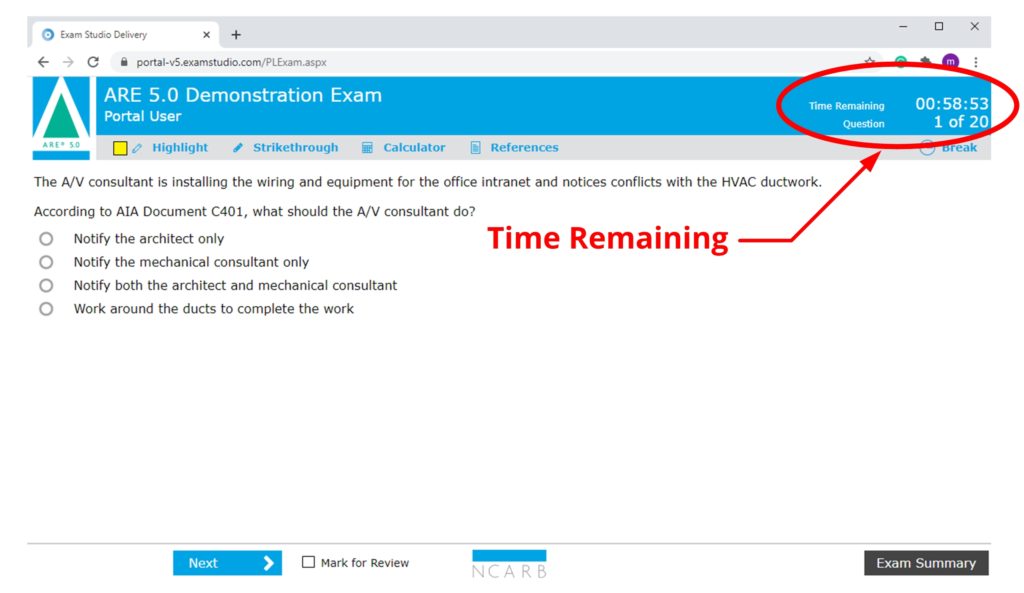
Then, check the Time Remaining clock. Determine how much time has passed, and if you're averaging >2 minutes or so (for discrete items), you’ll have to pick up the pace.
ARE 5.0 STRATEGY
Breaks are optional, but with appointments lasting up to 5 hours, you'll probably need at least one if not more. If you can plow through without stopping, great. If not, you need to plan ahead.
On the Project Planning & Design (PDD) division, for example, you get a total of 45 minutes of optional break time. Maybe you’ll take one long 45-minute break or three short 15-minute breaks. Whatever you decide, there’s a catch.
Each time you take a break, any ARE exam questions you’ve seen, answered, or not, will become locked. The same goes for case study questions. The scenarios and resources for any unseen case study questions remain unlocked, but if you’ve seen a question, it’ll be locked after a break. Consider each testing block like a self-contained exam. So, before you click the “Break” button, answer every ARE test question you saw during that testing block.
TIP: Scratch paper is not allowed during the ARE exam; instead, NCARB provides a digital "whiteboard." Get used to it before test day. Some ARE candidates hate it, some like it. Whatever your take, it's all you've got. Experiment with the NCARB practice exams, accessible through your My NCARB Account.
Okay, you're in the exam room (or your own room), you've started the exam, and the clock is ticking. But, before you start answering questions, get your bearings. The ARE 5.0 exam begins on the Exam Summary page. It takes just a few seconds to determine the number of Discrete Items (multiple-choice, check-all-that-apply, and hotspot), and the number of case studies and case study items.
Because answering a Case Study question relies on a particular Scenario and on the given Resource material, it takes longer than the 2+ minute average, but it's still worth only one point. Click the "Return to Exam" button to get started.
If you're starting with a case study, take note of the NCARB-provided Resource tabs. Don't spend much time digging into them. Just note which resources are available, so you know where to look for the answers.
Do, however, take a few minutes to familiarize yourself with the information in the Case Study Scenario tab. Read it carefully and let it percolate in the back of your mind while you get into the questions.
TIP: For PA, PPD, and PDD Divisions, get familiar with the IBC before your exam. You don't need to memorize it, but you should be familiar with its organization and chapter topics. Knowing how to look something up and where to find it will save you a ton of time during the ARE exam.
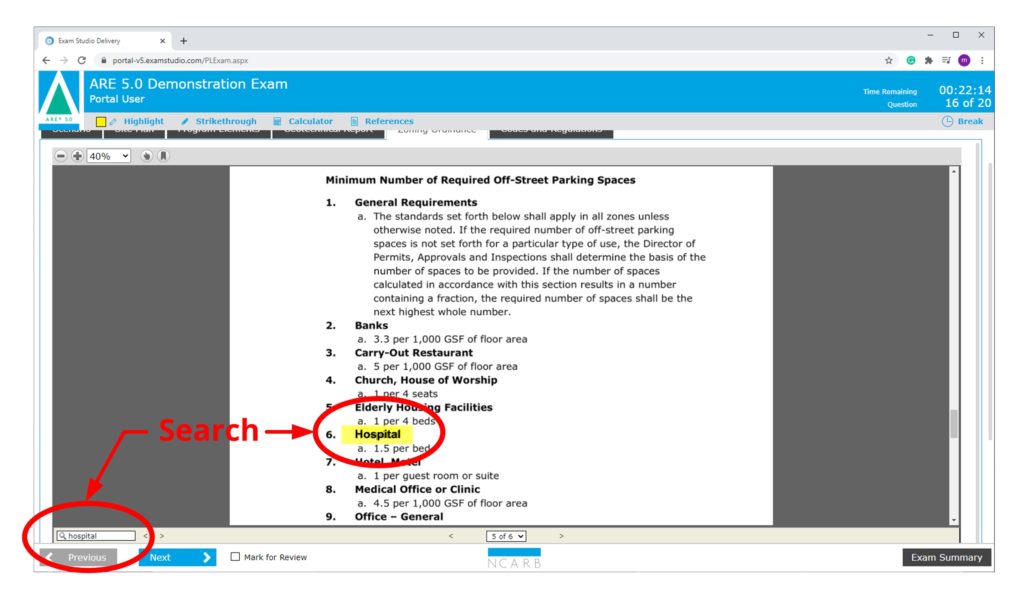
If you're not finding the right info in the Resources, use the Search feature. Searching for a key term within the tab will get you to the pertinent info more quickly.
An "easy'' question may take 30 seconds to answer. If you get it right, it's worth one point. But here's the thing. If it's going to take you 4+ minutes to answer a hard question, it's still worth only one point. Consider coming back to it later (before a break). Spend your time on the questions you're most likely to get right.
TIP: You can Highlight and Strikethrough text in the Scenario tab. BUT once you click Next or Previous, those markups disappear. Instead, mark up the questions and answers themselves. The markups will be there when you return.
When you get to a question that you can’t answer confidently, consider using the Highlighter tool to note key terms and/or possible answer choices. Also, use the Strikethrough tool to eliminate incorrect answer choices. If you have to come back to the question (again, before you take a break), you won’t have to start from scratch. Whenever possible, answer the question. Here's how to address ARE 5.0 questions you're unsure about.
If you have, say, 0% to 80% confidence in your answer, click the Mark for Review box  to flag the question. When you're ready to review your seen questions, before a break, click Exam Summary.
You'll see the questions you marked for review identified by a red flag. If you answered the question, it's labeled "Completed," if not, it's labeled "Incomplete." Now, click the Review Marked button to answer all of these questions.
Because unanswered ARE 5.0 questions are worth zero points, you need to answer every one to maximize your chances of passing, even if you have to make a wild guess. And yes, there's some strategy to it.
ARE 5.0 GUESSING?
With precious little time to tackle incomplete questions, you've gotta guess. The Discrete Items use the same three Item Types as the Case Studies, so the same recommendations apply.
For each ARE Item Type, there is a different time commitment and different odds of guessing the right answer. As you try to answer the marked questions, keep in mind the following recommendations for each Item Type, in order of value.
ARE Item Type: Multiple Choice Test Questions
Multiple-choice questions offer the best odds of guessing the correct answer. Answering blindfolded, your odds are 25%, or 33%, since some M.C. questions have only three answer choices. That's the same odds as winning a game of Rock, Paper, Scissors. Not bad. If you can eliminate one answer choice, now it's a coin flip, 50/50. Refer to your highlights and strikethroughs.
ARE Item Type: Hotspot
Hotspots require you to select a region of a drawing that represents the answer to the question. NCARB example, "Where is the thru-wall flashing required?" Once you make a decision, choosing a location only takes one click. Odds vary, so take your best shot.
ARE Item Type: Check-All-That-Apply
To answer these questions, you have to select the 2, 3, or 4 correct answer choices (out of six). Fortunately, NCARB tells you how many. For example, "Check the three that apply." Read carefully. It could be "two" or "four." If you're unsure about the correct answer choices, at least you know how many to select. Refer to your highlights and strikethroughs, try to eliminate any obviously incorrect options (distractors), and click the appropriate number of boxes.
Answer Everything!
It's like the lottery; You can't win if you don't play. To be clear, your priority while preparing for ARE 5.0 is to study hard and know your stuff. These ARE 5.0 strategies and recommendations will help you manage your time to avoid a last-minute meltdown. Time is short, you need every point you can get, and sometimes things get FUBAR. So, be as efficient as possible. Strategize by marking questions for review. And if you have to, guess.
Good luck from the CLARE crew!
Studying For ARE 5.0 — It’s Not Easy

Historically, candidates were tested in distinct repositories of information because the content covered by the Architect Registration Exam (ARE) was siloed. For example, all questions about mechanical systems were in one division, and questions about construction documents were in another. This compartmentalization made studying pretty straightforward. For the most part, it was one topic = one division. Studying for ARE 5.0, an exam that tests holistically, where the content is no longer... Read More
Making Sense of the ARE 5.0 Divisions

With each version of the Architect Registration Exam, NCARB attempts to make the ARE more reflective of the realities of practicing architecture. ARE 5.0 has come the closest thus far. Understanding the exam structure will help you maintain perspective as you approach each division. Due to overlap in the content within each group, some candidates find it beneficial to study for multiple divisions simultaneously. That approach does not work for everyone. What is helpful is studying the... Read More
Understanding Cognitive Complexity and the ARE 5.0
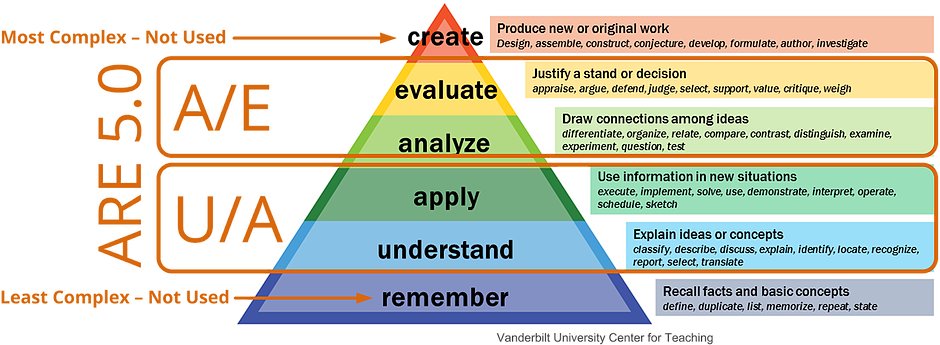
Within each ARE 5.0 division, specific learning objectives are defined with an expected level of cognitive complexity to assess your critical thinking skills. With the development of ARE 5.0, NCARB introduced two levels of cognition based on a modified model of Bloom's Taxonomy. In this modified model, NCARB excluded the two extremes, “Remember” (lowest cognitive level) and “Create” (highest cognitive level), and combined the remaining four levels of knowledge into two:... Read More
ARE 5.0 Practice Tests – “That’s all I want.”

Are you seeking out practice tests for the ARE 5.0? Contrary to popular test prep strategies, third-party practice tests might not be the answer to your ARE woes. Time and again, we hear candidates say, “I knew all the answers on the practice tests; why did I fail?” or “The practice tests were nothing like the questions I had on the ARE exam!” The ARE is a Standardized Test ... NOT! ARE 5.0 is unlike other standardized tests. Using practice tests to prepare for exams like the... Read More
Breaking Down an NCARB ARE 5.0 Sample Question

NCARB's ARE 5.0 multiple-choice questions are written so that only one answer choice is the best option. Because the remaining answer choices (distractors) are plausible, it’s the ARE candidate’s job to dissect the question (stem) for clues as to why one answer choice is better than another. Take this NCARB ARE 5.0 sample question, for example. During a routine site visit, the owner tells the architect to change the layout of two interior framed walls the contractor has already framed... Read More