Breaking Down an NCARB ARE 5.0 Sample Question

NCARB's ARE 5.0 multiple-choice questions are written so that only one answer choice is the best option. Because the remaining answer choices (distractors) are plausible, it’s the ARE candidate’s job to dissect the question (stem) for clues as to why one answer choice is better than another. Take this NCARB ARE 5.0 sample question, for example.
During a routine site visit, the owner tells the architect to change the layout of two interior framed walls the contractor has already framed based on the construction documents. The framing changes will not have an impact on any code-related issues. Since the owner is adamant the walls be reframed, which of the following should the architect do?
A. Ask the contractor to schedule a meeting on-site with the owner, architect, and framing subcontractor to review the changes
B. Review the expected effect on construction cost and schedule with the contractor, then prepare a change order for owner review
C. Issue a construction change directive, with a requirement for time and material invoices to be submitted for the work
D. Include documentation of the discussion and a drawing
Let’s break this ARE question stem down into its various elements:
"During a routine site visit,"
It was not one of the architect’s two required inspections (no substantial/final completion issues).
"the owner tells the architect to change the layout of two interior framed walls"
The owner wants something changed. Presumably, the owner does not expect the architect to pick up a hammer and begin reframing.
"the contractor has already framed based on the construction documents."
That portion of the work is done and it is in accordance with the construction documents.
"The framing changes will not have an impact on any code-related issues."
The proposed changes are within the general scope of the contract.
"The owner is adamant the walls be reframed per their new request."
The proposed changes must be made.
Which of the following should the architect do?
A. Ask the contractor to schedule a meeting on-site with the owner, architect, and framing subcontractor to review the changes
B. Review the expected effect on construction cost and schedule with the contractor, then prepare a change order for owner review
C. Issue a construction change directive, with a requirement for time and material invoices to be submitted for the work
D. Include documentation of the discussion and a drawing
Many candidates choose “B” (prepare a change order), which seems reasonable. However, the most correct answer choice is “C” (issue a construction change directive).
Why? Because the owner is “adamant.” This is the one clue to selecting the correct answer. Even though the contractor and owner have yet to agree on any change in cost or time, the owner’s inexorable decision to change the layout of the two walls can be ordered via a construction change directive.
Here’s the relevant article from AIA Document A201-2017:
§ 7.3.1
A Construction Change Directive is a written order prepared by the Architect and signed by the Owner and the Architect, directing a change in the Work prior to agreement on any adjustment to the Contract Sum or Contract Time, or both. The Owner may by Construction Change Directive, without invalidating the Contract, order changes in the Work within the general scope of the Contract consisting of additions, deletions or other revisions, the Contract Sum and Contract Time being adjusted accordingly.
In reality, depending on the scope of the requested change, one of several scenarios might play out. It’s possible that, if the contractor is feeling particularly charitable, the walls might just be reframed, no questions asked. However, because the owner is “adamant,” there is only one best option. If the owner were merely interested, any of the answer choice distractors might suffice.
ARE 5.0 – Don’t Forget about Time, Strategy, and Guessing

Passing the Architect Registration Exam, ARE 5.0, isn't just about knowing the exam content; it's also about strategy. You've got to apply multiple test-taking strategies to boost your odds. The truth is, time management is critical to squeeze every point out of this exam. There's no time to spare, especially when you get into the Case Study questions, which account for 10% to 20% of each exam. So, lock yourself in a quiet room, log in to your NCARB Record, and spend some quality time with... Read More
Studying For ARE 5.0 — It’s Not Easy

Historically, candidates were tested in distinct repositories of information because the content covered by the Architect Registration Exam (ARE) was siloed. For example, all questions about mechanical systems were in one division, and questions about construction documents were in another. This compartmentalization made studying pretty straightforward. For the most part, it was one topic = one division. Studying for ARE 5.0, an exam that tests holistically, where the content is no longer... Read More
Making Sense of the ARE 5.0 Divisions

With each version of the Architect Registration Exam, NCARB attempts to make the ARE more reflective of the realities of practicing architecture. ARE 5.0 has come the closest thus far. Understanding the exam structure will help you maintain perspective as you approach each division. Due to overlap in the content within each group, some candidates find it beneficial to study for multiple divisions simultaneously. That approach does not work for everyone. What is helpful is studying the... Read More
Understanding Cognitive Complexity and the ARE 5.0
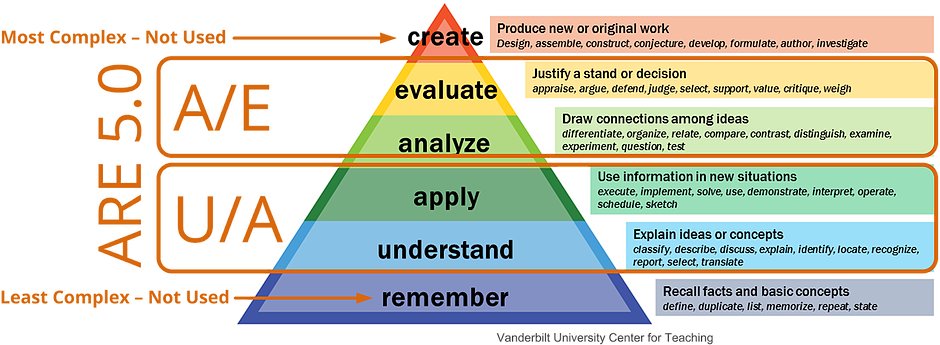
Within each ARE 5.0 division, specific learning objectives are defined with an expected level of cognitive complexity to assess your critical thinking skills. With the development of ARE 5.0, NCARB introduced two levels of cognition based on a modified model of Bloom's Taxonomy. In this modified model, NCARB excluded the two extremes, “Remember” (lowest cognitive level) and “Create” (highest cognitive level), and combined the remaining four levels of knowledge into two:... Read More
ARE 5.0 Practice Tests – “That’s all I want.”

Are you seeking out practice tests for the ARE 5.0? Contrary to popular test prep strategies, third-party practice tests might not be the answer to your ARE woes. Time and again, we hear candidates say, “I knew all the answers on the practice tests; why did I fail?” or “The practice tests were nothing like the questions I had on the ARE exam!” The ARE is a Standardized Test ... NOT! ARE 5.0 is unlike other standardized tests. Using practice tests to prepare for exams like the... Read More