ARE 5.0 Practice Tests – “That’s all I want.”

Are you seeking out practice tests for the ARE 5.0? Contrary to popular test prep strategies, third-party practice tests might not be the answer to your ARE woes. Time and again, we hear candidates say, “I knew all the answers on the practice tests; why did I fail?” or “The practice tests were nothing like the questions I had on the ARE exam!”
The ARE is a Standardized Test ... NOT!
ARE 5.0 is unlike other standardized tests. Using practice tests to prepare for exams like the ACT/SAT, GRE, and LSAT can improve your score. You can easily find actual tests used in the past to test your knowledge of predictable data under the prescribed time constraints and expect a similar outcome on test day. Practice tests for these exams are useful for analyzing performance. If you are weak in Algebra, you can practice solving similar problems over and over again. Taking numerous old versions of actual tests for practice will help you solve problems correctly and quickly on test day.
When it comes to the ARE 5.0, this is not the case. The most effective practice tests, however, are those from NCARB. Fortunately, they provide an exam for each division, updated in 2026. They are NOT questions from the actual exam, nor any past exam. Still, they're the best practice test you can take—well, almost. There's nothing quite like taking an actual ARE 5.0 exam. While time and cost are drawbacks here, there is no penalty for failing, and each retake is like a separate practice test. By taking the ARE 5.0, you’ll gain a sense of the depth of knowledge required and experience the actual test conditions and time constraints. Unlike practice exams, you won’t know which questions you got wrong or right, and there will not be any explanations. But, you will learn which content areas to focus on by reviewing your NCARB score report, get your feet wet, and know what to expect moving forward.
"Practice Effect"
Test developers and NCARB know that whenever a candidate takes the ARE 5.0, they have ‘practiced’ taking the exam. “The more ‘practices’ a candidate has, the better chance for a higher score. This increase in scores is called a practice effect, so NCARB has multiple forms in circulation for each division. Additionally, there is a waiting period of 60 days before you can retest a failed division. Certification examinations are designed to ensure that those achieving the credential possess the appropriate level of knowledge.” Test Development: Ten Steps to a Valid and Reliable Certification Exam
Actual ARE test questions aim to assess whether the candidate has enough knowledge in essential areas to practice architecture. NCARB questions and answer choices have been rigorously evaluated to determine their accuracy, efficacy, fairness, the appropriate level of cognitive complexity, and value in identifying strong, average, and weak candidates. A practice test question is only as good as its creator. Often, third-party practice questions are based on the creator’s study materials and are not subject to NCARB-level vetting, which they outline in the latest ARE Guidelines.
There are, however, two potential benefits to taking a third-party ARE 5.0 practice test: one is the answer explanations. This benefit depends on the quality and depth of the explanations given, not only for the correct answer but also why the other choices are wrong. And two, the benefit of actively recalling information that you’ve studied. With multiple-choice practice, you start memorizing the questions and correct answers instead of learning the actual content.
Doing It Anyway
ARE 5.0 practice exam results are not indicative of future performance and may give you an inaccurate sense of readiness. In a recent study from Harvard, researchers found that your “perception of how much you feel you’ve learned and understood does not correlate with what you’ve actually learned.” If you’re going to take practice tests anyway, use them to study the topics presented. Because unless you have the same question and answer choices on your actual ARE, you could be in trouble.
Breaking Down an NCARB ARE 5.0 Sample Question

NCARB's ARE 5.0 multiple-choice questions are written so that only one answer choice is the best option. Because the remaining answer choices (distractors) are plausible, it’s the ARE candidate’s job to dissect the question (stem) for clues as to why one answer choice is better than another. Take this NCARB ARE 5.0 sample question, for example. During a routine site visit, the owner tells the architect to change the layout of two interior framed walls the contractor has already framed... Read More
ARE 5.0 – Don’t Forget about Time, Strategy, and Guessing

Passing the Architect Registration Exam, ARE 5.0, isn't just about knowing the exam content; it's also about strategy. You've got to apply multiple test-taking strategies to boost your odds. The truth is, time management is critical to squeeze every point out of this exam. There's no time to spare, especially when you get into the Case Study questions, which account for 10% to 20% of each exam. So, lock yourself in a quiet room, log in to your NCARB Record, and spend some quality time with... Read More
Studying For ARE 5.0 — It’s Not Easy

Historically, candidates were tested in distinct repositories of information because the content covered by the Architect Registration Exam (ARE) was siloed. For example, all questions about mechanical systems were in one division, and questions about construction documents were in another. This compartmentalization made studying pretty straightforward. For the most part, it was one topic = one division. Studying for ARE 5.0, an exam that tests holistically, where the content is no longer... Read More
Making Sense of the ARE 5.0 Divisions

With each version of the Architect Registration Exam, NCARB attempts to make the ARE more reflective of the realities of practicing architecture. ARE 5.0 has come the closest thus far. Understanding the exam structure will help you maintain perspective as you approach each division. Due to overlap in the content within each group, some candidates find it beneficial to study for multiple divisions simultaneously. That approach does not work for everyone. What is helpful is studying the... Read More
Understanding Cognitive Complexity and the ARE 5.0
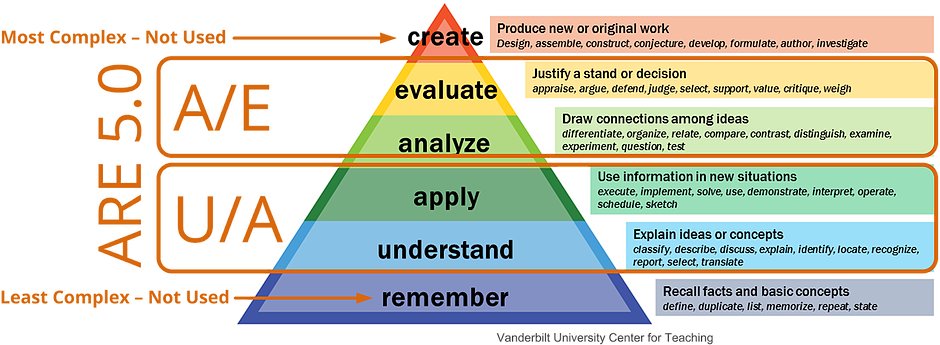
Within each ARE 5.0 division, specific learning objectives are defined with an expected level of cognitive complexity to assess your critical thinking skills. With the development of ARE 5.0, NCARB introduced two levels of cognition based on a modified model of Bloom's Taxonomy. In this modified model, NCARB excluded the two extremes, “Remember” (lowest cognitive level) and “Create” (highest cognitive level), and combined the remaining four levels of knowledge into two:... Read More